

Geothermal systems are going in faster than ever across Knox, Blount and Loudon counties right now, and there’s one question that comes up before any of the others. How long will it last? It’s the right thing to ask, honestly, because geothermal costs more upfront than a conventional furnace and air conditioner and the whole thing only pencils out if the equipment stays in service for decades.
Short version, installed properly, one of these outlives nearly everything else in the house. The longer version depends on three things: which half of the system you mean, how the ground loop got sized for East Tennessee soil, and whether anybody has been giving it the annual attention and whatever geothermal repair it needed along the way. Understand those three and you can plan, budget, and tell when geothermal repair beats replacement.
A few numbers worth carrying into this:
- Against conventional heating and cooling, the Department of Energy has geothermal heat pumps running on 25% to 50% less electricity. Stretch that across a long service life and the operating savings keep compounding on you.
- Two very different clocks in play. Ground loop piping carries a 50 year rating. The indoor heat pump equipment goes 20 to 25 years. So the indoor half gets replaced once while the loop is still down there working away.
- The EPA and the Department of Energy both file geothermal among the most efficient residential heating and cooling technologies you can buy. That rating assumes somebody is maintaining and repairing the thing on schedule, mind you.
What actually decides how long one geothermal system lasts
Two systems, really, working together and aging at completely different rates. Treat them as one machine and you’ll misjudge when to call somebody, which is the usual reason requests for geothermal repair land later than they should have. Sort out which half you’re dealing with and the timelines get a lot easier to plan around.
The ground loop will outlast everything else in the house
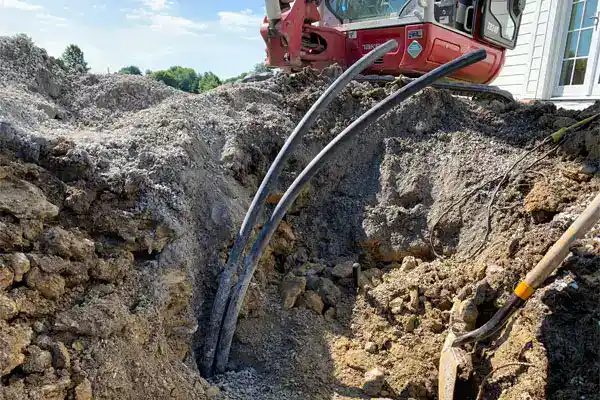
Buried part of your system is a sealed circuit of high density polyethylene pipe. Nothing moves down there. No combustion. No weather. The pipe gets fused rather than glued, which makes joints as strong as the pipe on either side of them. Manufacturers routinely warrant this piping for 50 years, and there are field installations from the 1980s still circulating fluid this afternoon.
Because it’s that durable, geothermal repair almost never involves the ground. When it does, the cause is nearly always something from outside, like excavation for a new driveway or a failed connection where the loop enters the house. Both are fixable without touching the rest of the field. Even in the rare case where a buried section takes damage, a technician isolates the affected circuit, digs out only that length of pipe, and fuses in a replacement. Contained geothermal repair, not a rebuild.
The heat pump unit indoors
Indoor cabinet is where the compressor lives, along with the circulating pump, the blower motor, the reversing valve and the controls. Mechanical parts, cycling thousands of times a season, wearing the way mechanical parts wear. Expect 20 to 25 years out of a quality unit, which is noticeably better than the 12 to 15 you’d get from an air source heat pump, and the reason is simple: this one never sits outdoors fighting Tennessee humidity and ice and August.
Most geothermal system repair work happens right here. Compressor contactors, circulator pumps, control boards, those are what fail first, and every one of them is straightforward to swap. None of those failures shortens the life of the system overall either, as long as the geothermal repair actually happens promptly instead of after six months of the unit limping along compromised.
Soil, water table, and Tennessee clay
We’re sitting on a mix of limestone, shale and heavy clay around here, with karst formations through a lot of it. That geology decides how efficiently heat moves in and out of the ground, which decides how hard your compressor has to work.
Size a loop correctly for dense clay and it’ll run comfortably for decades. Size one as though it were going into sandy soil and the compressor labors every winter, which shortens its life and produces repeat geothermal repair calls that never quite land on the real problem. Worth asking about if you bought a house with a system already in it, because the original sizing calculations don’t always come with the paperwork, and a mismatch only announces itself during the coldest stretch of the year.
The real numbers of geothermal systems for East Tennessee homes
National averages are useful right up until local conditions move them. Here’s what those numbers look like for houses between Knoxville and the Smokies.
What fifty years actually means for a geothermal system
Fifty years isn’t marketing language. It comes out of the pressure rating and the stress crack resistance of the polyethylene they use in closed loop fields. Practically speaking, somebody who installs geothermal at 40 will probably never replace the loop. It becomes part of the property the way a well or a septic field does, and it goes to the next owner with the house.
That’s also why geothermal repair costs stay low across the life of one of these compared with conventional equipment. Furnace and condenser, you’re replacing the whole investment every 15 years or thereabouts. Geothermal, the biggest single expense happens one time.
Why the indoor geothermal system retires first
At the 20 year mark a geothermal heat pump is usually still running fine. What changes by then is the question. It stops being whether the thing runs and turns into whether it runs efficiently enough to be worth holding onto, because compressor efficiency slides a little every year while refrigerant technology and control systems keep getting better without you.
Plenty of homeowners replace the indoor unit somewhere between year 20 and year 25 and reuse the existing loop, which cuts the cost of that second installation dramatically, because the expensive excavation happened decades ago. Up until that window, geothermal repair on the cabinet you’ve got is the sensible path. Replacing a circulator pump at year 12 costs a fraction of replacing a cabinet with another decade of service in it.
How our climate stretches the timeline of a geothermal system
East Tennessee treats geothermal equipment well. Winters get cold enough to make the efficiency gains meaningful without being the brutal sustained cold of the upper Midwest that holds systems at their design limits for months at a stretch. Summers are humid, and that humidity load counts for something, but down at loop depth the ground temperature stays remarkably steady all year.
Net result is a system spending most of its life in a moderate operating band, which happens to be the exact condition that extends equipment life and keeps geothermal repair frequency low across the whole time you own the place.
Warning signs your geothermal system wants attention
Geothermal systems are quiet and out of sight, which is both a blessing and a problem. They rarely fail dramatically. What they do instead is drift, shedding efficiency a little at a time until the utility bill finally gets somebody’s attention.
The bill went up and nothing else did
Earliest and most reliable signal there is. December bill climbs 20% over last December while nothing about your household changed, and something in that system is working harder than it ought to. Low loop pressure, a circulator on its way out, a refrigerant charge that’s drifted out of spec, all of them show up on the bill months ahead of showing up as an actual comfort complaint. Catch it there and geothermal repair is cheap. Keep a simple record of your winter and summer bills so the year over year comparison takes ten seconds.
Weak airflow and rooms that don’t match
When some rooms never quite hit the thermostat setting, the instinct is to blame the ductwork. Sometimes that’s right. Often enough it’s pointing at a blower motor losing speed, a clogged coil choking heat transfer, or a loop that’s no longer moving fluid at design flow.
A tech measures the temperature difference across the coil and the pressure drop across the loop, and those two numbers generally identify the problem inside of a few minutes. Move on weak airflow early and the geothermal repair stays limited to one component, rather than letting the compressor run strained for an entire season.
Noises, cycling trouble and error codes
A geothermal unit should be close to silent. Gurgling means air in the loop. Rhythmic clicking usually means a relay or contactor is going. Short cycling, where it starts and stops repeatedly without ever finishing a cycle, points at a control or sizing issue and puts genuine stress on the compressor.
Modern units also log fault codes, and those codes are the fastest route to accurate geothermal repair going, because they tell the technician exactly what the system saw right before it shut itself down.
How maintenance adds years for a geothermal system
The difference between a geothermal system that gives you 18 years and one that gives you 25 is almost entirely maintenance. None of it is complicated and most of it fits in one visit a year.
The annual service visit
A proper annual runs through electrical connections, refrigerant pressures, airflow measurements, control calibration and loop performance, and it’ll take somebody 60 to 90 minutes to do right. The value isn’t in whatever gets fixed that day. It’s in what gets caught before it turns into a failure.
A contactor showing pitting gets replaced for very little money, instead of welding itself shut in January and taking the compressor down with it. That one distinction is the whole difference between routine service and emergency geothermal repair, and emergency work costs more than planned work every single time.
Loop pressure and antifreeze
Closed loops are sealed, which doesn’t make them immune to slow pressure loss at fittings and valve packings. Let pressure drop below design and the circulator cavitates and heat transfer falls away.
Antifreeze concentration matters just as much, because an underprotected loop can allow ice to form at the heat exchanger during deep winter operation. Both are five minute checks on an annual visit. Both prevent expensive geothermal repair later on.
Filters, coils and condensate
Airflow is the single biggest lever you personally control. A restricted filter makes the blower work harder and drops heat transfer across the coil, which raises head pressure and takes years off the compressor. Slow problem, and it eventually arrives as a geothermal repair bill.
So: filters on schedule, return grilles kept clear, coil cleaned professionally every few years. Condensate line goes on that list too. Let a drain block up in a humid Tennessee summer and the safety switch trips and the whole system shuts itself off.
Deciding between repair and replacement of a geothermal system
Every system reaches this point eventually. Good news with geothermal is that the decision is usually simpler than it is with conventional equipment, since the most expensive component is already in the ground and staying there.
When geothermal repair clearly wins
Under 15 years old with a discrete component failure and repair wins nearly every time. Circulator pumps, blower motors, control boards, contactors, expansion valves, sensors. All serviceable, all reasonably priced. Same goes for loop side problems like a leaking header connection.
In every one of those cases geothermal repair puts full performance back into a system with years of design life still ahead of it, and the cost is a small fraction of a new installation.
When replacement makes more sense
Math changes when the compressor fails on a unit that’s 20 or older, or when the heat exchanger develops a leak. Now you’re spending a significant share of replacement cost on a cabinet near the end of its service life regardless. A newer unit will also be measurably more efficient, so the operating savings help close the gap. Even then, notice what the conversation is about: the indoor equipment. Not the loop.
What replacement actually involves
Swapping the indoor unit on an existing loop is a one day job in most houses. Loop gets flushed and pressure tested, new cabinet goes in and gets connected, refrigerant lines are charged, controls get commissioned. No excavation. No torn up yard.
Homeowners are frequently surprised that the second system costs so much less than the first one did. That surprise is the actual payoff of a loop built to outlast the house.
Questions we field about these
How long does the ground loop actually last? 50 years or better, commonly. Fused polyethylene, nothing moving, buried below the frost line and out of the weather entirely. Most people never replace one at all, and when you sell, it goes with the house.
And the indoor heat pump? 20 to 25 years typically, where an air source heat pump gives you 12 to 15. Most of that difference comes down to one thing: this one lives in conditioned space instead of sitting outside taking weather year round.
What are the first signs I need geothermal repair? A utility bill climbing with no change in household habits is usually earliest. After that comes weak airflow, rooms that won’t match each other, gurgling or clicking, short cycling. The unit’s own fault codes will frequently confirm what’s going on, and that’s exactly why a technician pulls the fault history before starting any geothermal repair.
Does East Tennessee soil affect how long my system lasts? It does. Heavy clay and limestone move heat differently than sandy soil, so loop sizing has to account for local geology. A loop sized right for this region keeps the compressor in a comfortable operating range. An undersized one makes it work harder every winter and leads to repeat repairs.
How often does it need servicing? Annually. Somebody goes through electrical connections, refrigerant pressures, airflow, controls and loop pressure, spends 60 to 90 minutes on it, and catches the small problems while they’re still small.
Mine’s 20 years old. Still worth repairing? Depends what failed. Discrete component failures, a circulator pump or a control board, are still worth repairing. A failed compressor or a leaking heat exchanger at that age generally points toward replacing the indoor unit and keeping the loop. Ask for both numbers, the geothermal repair estimate and the replacement estimate, before you decide anything.
Will I have to dig up my yard when it gets replaced? Almost never. Replacement normally means the indoor cabinet only. The loop gets flushed, pressure tested and reconnected to the new unit, which is exactly why the second installation costs considerably less than the first.
Getting the most out of your system
Installed and maintained properly in East Tennessee, a geothermal system should hand you two decades of quiet efficient comfort from the indoor unit and a lifetime out of the loop. The homeowners who get there are the ones treating small problems as small problems, booking the annual visit, and calling for geothermal repair the first time a bill stops making sense.
If your system is showing any of the signs above, or it’s been over a year since anybody looked at it, this is the moment to get it checked. Heading into winter with a system that’s already struggling is precisely how a minor geothermal repair becomes a January emergency. A quick inspection now protects your comfort and the decades of service life the thing was built to give you.