

Of everything plugged in at your house, the heat pump probably puts in the longest hours, because it spends a humid Tennessee summer keeping you cool and then turns right around to keep you warm all winter, and a lot of the time it goes months without what you’d call a real break. So when it starts blowing lukewarm air, or making some noise you’ve never once heard out of it, the first question in most people’s heads isn’t really what broke, it’s how much this is going to cost.
We can offer some good news on that front, since most heat pump repair bills turn out quite a bit smaller than people brace themselves for, and the ugly surprises nearly always trace back to waiting too long, skipping maintenance, or hiring somebody who wouldn’t give a price upfront. Once you know what actually drives heat pump repair pricing, you can budget for it with some confidence and quit paying for problems that never needed to happen.
Some numbers to keep in mind while you read:
- The typical heat pump repair comes to about $400, and most homeowners’ bills land somewhere in the $150 to $650 range.
- Replacing the whole heat pump averages around $8,350, more than twenty times what a typical repair costs, and if you ever needed one number to convince you that catching problems early is worth the trouble, that would be the one.
- According to the U.S. Department of Energy, a heat pump that gets looked after uses 10 to 25 percent less energy than one that’s been badly neglected, which means skipping service was never really free, it just shows up a little at a time on the monthly bill.
What drives heat pump repair costs
No two repair bills ever look quite the same, but three things end up doing most of the work in deciding what you’ll pay.
The part that failed
The biggest one by far is simply which part gave out. There are dozens of components in a heat pump, from cheap little electrical pieces all the way up to the compressor, which is the expensive heart of the whole system, and a dead capacitor might be a quick, affordable swap while a compressor replacement can cost more than some families spend on a vacation. That spread is exactly why a proper diagnosis matters so much, because putting in the wrong part is money down the drain, and treating the symptom rather than the cause just means you’ll be on the phone about heat pump repair again a few weeks from now.
Labor, diagnostics and when you call
Most companies charge a service call or diagnostic fee just for coming out and figuring out what’s wrong, and nationally that tends to run somewhere around $50 to $200 for the visit, with hourly labor usually falling between $75 and $150 on top. When you call makes a difference too, since anything scheduled during regular business hours will nearly always cost less than an emergency visit on a holiday weekend or at two in the morning. If your system is already giving you early warning signs, getting someone out before it quits entirely keeps the schedule and the price in your hands instead of the other way around.
Your system’s age, type and warranty
Older systems tend to need more work, and if the model’s been discontinued, the parts get harder to find and pricier when you do find them. What kind of heat pump you have plays into it as well, because the standard air-source units most people have are usually the cheapest to fix, whereas ductless mini splits and geothermal systems can need specialized parts and somebody who really knows them. And it’s worth digging out the paperwork from the install, since plenty of manufacturer warranties cover major parts for 5 to 10 years (especially if the unit got registered afterward), which means a repair that sounds scary might only cost you the labor.
While we’re on average, heat pump repair runs around $400 compared with roughly $275 for general HVAC system repairs, and the reason for the difference is that heat pumps run all year and have parts in them that a standard air conditioner just doesn’t have.
Common heat pump repair costs by problem
Knowing roughly what things cost makes it a lot easier to tell a fair quote from a bad one, and to plan ahead a little. These figures come from national cost data, so what you’d pay locally could run a bit higher or lower depending on the house and the system.
Small electrical fixes: capacitors, contactors and thermostats
When a heat pump won’t start, or keeps shutting itself off for no obvious reason, it’s most often something electrical, and luckily those are also the cheapest fixes on the list, with a capacitor or contactor generally running $120 to $400 and thermostat work somewhere around $80 to $350. Heat and constant cycling wear these parts out over time, particularly in systems that grind through long Southern summers, and a capacitor that’s getting weak usually gives you a heads-up first, like an outdoor unit that hums or a fan that seems to struggle getting up to speed. If you catch it right there, that’s one of the easiest ways to keep a small heat pump repair from turning into a big one.
Mid-range repairs: fan motors, refrigerant leaks and the reversing valve
In the middle you’ve got the parts that take more time and more skill to replace, like a fan motor, which typically lands between $200 and $700, or a refrigerant leak, where finding it and fixing it can run anywhere from $300 to $1,200.
The reversing valve gets its own paragraph because it’s something only heat pumps have, and it’s the part that flips your system between heating and cooling, so when it sticks you can end up with cool air in January or warm air in July. Some national estimates put a reversing valve replacement between $400 and $1,500, and of all the repairs out there it’s the one that most often catches people off guard, which is why, if your system seems stuck in the wrong mode, the move is to call a technician rather than keep poking at the thermostat.
The big ones: compressors and coils
Then there’s the compressor, the part that keeps refrigerant moving through the whole system, and when it fails you’ll feel it in the wallet, since compressor work commonly comes to $650 to $2,400 and some estimates go as high as $4,500 for a full replacement. Coils aren’t a whole lot kinder, honestly, with an evaporator coil replacement generally running $650 to $2,400 and a condenser coil somewhere between $900 and $2,300. These are the heat pump repair situations where the repair-or-replace question really matters, especially on a system that’s more than a decade old.
Warning signs that lead to expensive repairs
Most big failures give you plenty of warning, and the trick is knowing what you’re looking at, because a small problem that gets left alone has a habit of taking out the parts around it.
Heat that feels lukewarm or blows cold
A heat pump was never going to give you the blast of heat a gas furnace does, so air from the vents that feels a little milder than you’re used to isn’t anything to worry about. Air that actually feels cool is another matter, though, and so is a house that can’t get up to whatever you’ve set on the thermostat, and the usual suspects there are low refrigerants, a reversing valve on its way out, or a unit that’s gotten stuck in defrost mode. Calling for heat pump repair at this point usually means one targeted fix instead of a whole-system headache.
Strange noises, ice buildup and short cycling
Grinding, squealing, rattling or loud clicking all mean something mechanical is starting to wear out. A thin layer of frost on the outdoor unit on a cold morning is completely normal, and the system melts it off by itself during the defrost cycle, but a thick coat of ice that just sits there for hours is a different story.
Short cycling, where the system kicks on and off every few minutes, is another red flag, and a serious one, because all that starting and stopping is hard on the compressor, which happens to be the most expensive part you own. If you keep a system running with an electrical fault or low refrigerant, it can overheat and ruin that compressor, and then a roughly $300 fix has turned into a $3,000 job.
Rising energy bills with no explanation
If your electric bill jumps while you’re using the house the same as always, your heat pump may be losing efficiency, since dirty coils, low refrigerant, a clogged filter or a part that’s failing will all make the system run longer to get the same job done. Plenty of homeowners also start noticing the backup electric heat strips coming on more often, which is about the most expensive way there is to heat a house, and we get into that in why your heat pump runs constantly in cold weather. An unexplained spike on the bill is often your earliest and cheapest chance to schedule heat pump repair, well before the house starts feeling any different.
Repair or replace? How to make the smart money call
Everybody with a heat pump hits this question eventually, and there isn’t one answer that fits every house, because it comes down to the system’s age and the price of this particular repair, plus how well the thing has held up lately.
The age and cost rule
There’s a simple rule of thumb in the HVAC world that goes like this: multiply the age of your heat pump by what the repair costs, and if you get more than $5,000, replacement deserves a serious look. So a $600 repair on a 5-year-old system gives you $3,000 and repairing it makes sense, while that exact same $600 repair on a 12-year-old system gives you $7,200, which leans pretty hard toward replacement. It’s not a law or anything, but it’s a good place to start the conversation with your technician.
When repair clearly wins
Heat pump repair is almost always the right call on a system under 10 years old that’s been reliable up to now, particularly when the fix is a smaller part like a capacitor or fan motor. It also makes sense any time a major part is still under warranty, and in situations like those, spending a few hundred dollars can buy you years more of dependable service and keep thousands in your pocket.
When replacement saves you more
Replacement starts making more sense once the compressor dies on an older system, and the same goes for a unit that’s needed something fixed every year for a while now, or one that still runs on R-22 refrigerant, which has been phased out and is getting very expensive to find. Replacing isn’t cheap either, running from about $4,500 to $15,000 or more depending on the equipment and how tricky the install turns out to be, though a new high-efficiency system can take a real bite out of your monthly bills and may qualify for utility rebates or tax incentives. A heat pump repair service worth trusting will walk you through both options honestly instead of steering you to the pricier one, and if a new heat pump installation really does come out ahead, you should get that quote in the same plain terms.
How to avoid surprise heat pump repair bills
You can’t stop every breakdown, but you can make most of them a whole lot less likely, and a whole lot cheaper when they do happen.
Schedule maintenance twice a year
Since a heat pump never really gets an off-season, it does best with two check-ups a year, one in the spring before you need cooling and one in the fall before you need heat. You’re usually looking at $70 to $200 for a single tune-up, or about $120 to $360 for an annual maintenance plan, and on a heat pump maintenance visit the technician is cleaning coils and checking refrigerant and testing the electrical side, which really amounts to hunting down the worn parts before they get the chance to fail on you. That small, predictable cost is honestly the best protection you’ve got against a big, unpredictable heat pump repair bill showing up in the middle of January.
Handle the simple homeowner tasks
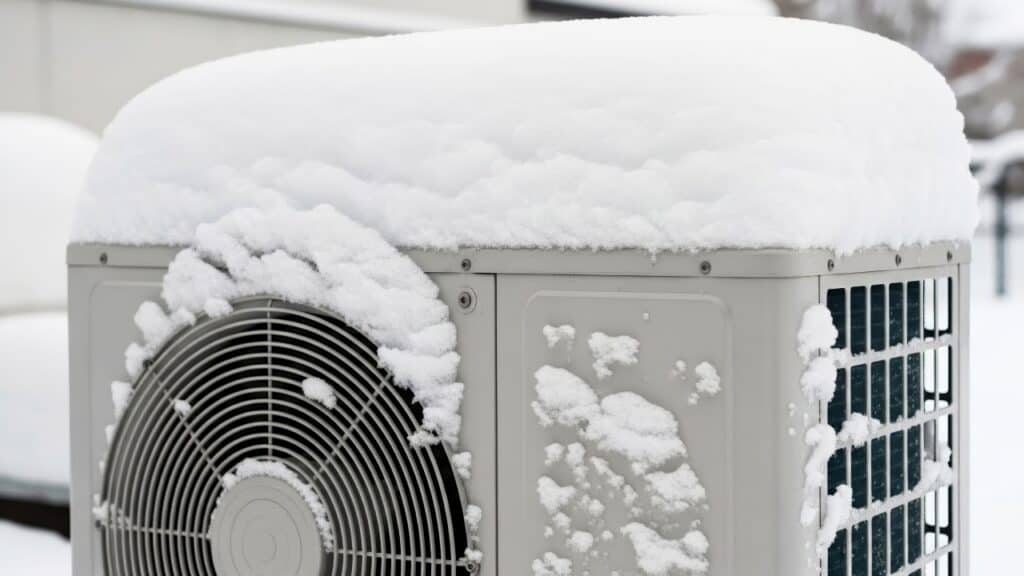
There are a few easy habits that go a long way here. Change or clean your air filter every one to three months, since a clogged filter chokes the airflow and makes every part of the HVAC system work harder than it needs to, and keep at least two feet of open space around the outdoor unit, rinsing off the leaves and grass clippings and whatever else piles up there. After a winter storm, gently clear the snow or ice from around the base so the unit can breathe, but please don’t go chipping at the ice with anything sharp, because a damaged coil leads straight to another heat pump repair.
Why the heat pump repair price should come before the work
Think back to the last time a bill really surprised you, and odds are there was a vague estimate somewhere near the start of it. That’s why we’d tell anybody to get the quote in writing before a single panel comes off, with parts and labor and fees each on their own line, and to ask two more things while the technician is standing right there, namely whether the diagnostic fee comes off the repair and what kind of warranty covers the work. You also want somebody licensed and insured who’ll talk to you like a neighbor would, and who doesn’t mind holding up the burned-out part so you can see what you’re paying for. A good heat pump repair company gives you enough to decide for yourself, and it won’t try to rush you while you do.
Questions homeowners ask us about heat pump repair
How much does heat pump repair cost on average?
Plan on something close to $400, since that’s what most people pay and the bulk of repairs fall between $150 and $650, although a compressor or coil job is its own animal and can run into the thousands.
Is heat pump repair more expensive than AC repair?
It usually is, since a heat pump works all year long and carries parts like the reversing valve that a plain air conditioner never had, and that pushes the average heat pump repair above what a typical HVAC repair costs.
What is the most expensive heat pump repair?
That’d be the compressor, which commonly runs anywhere from several hundred to a few thousand dollars, and on an older system it often makes more sense to put that money toward replacing the whole unit.
Can I keep running my heat pump if it needs repair?
We wouldn’t, because running a system with an electrical fault or low refrigerant can overheat the compressor and damage it, and then a modest repair has become a very expensive one.
How can I lower my heat pump repair costs?
Honestly, most of it is the boring stuff, like twice-a-year maintenance and a filter changed on schedule and an outdoor unit that isn’t buried in leaves, plus calling somebody the first time you notice something’s off rather than the fifth, because catching a problem early is the most reliable way we know to keep a heat pump repair small.
When your heat pump starts acting up, don’t wait around for it to quit on the coldest night of the year. Chancey Reynolds provides heat pump repair across the Knoxville area with upfront pricing and technicians who’ll explain your options clearly, and whether it turns out to be a quick capacitor swap, a reversing valve replacement or you just want an honest opinion on repair versus replacement, our team will get your home comfortable again. Schedule your heat pump repair today and head into winter with some peace of mind.